Memorial Day 🇺🇸
To those who made the ultimate sacrifice...

A Salute from Anita…
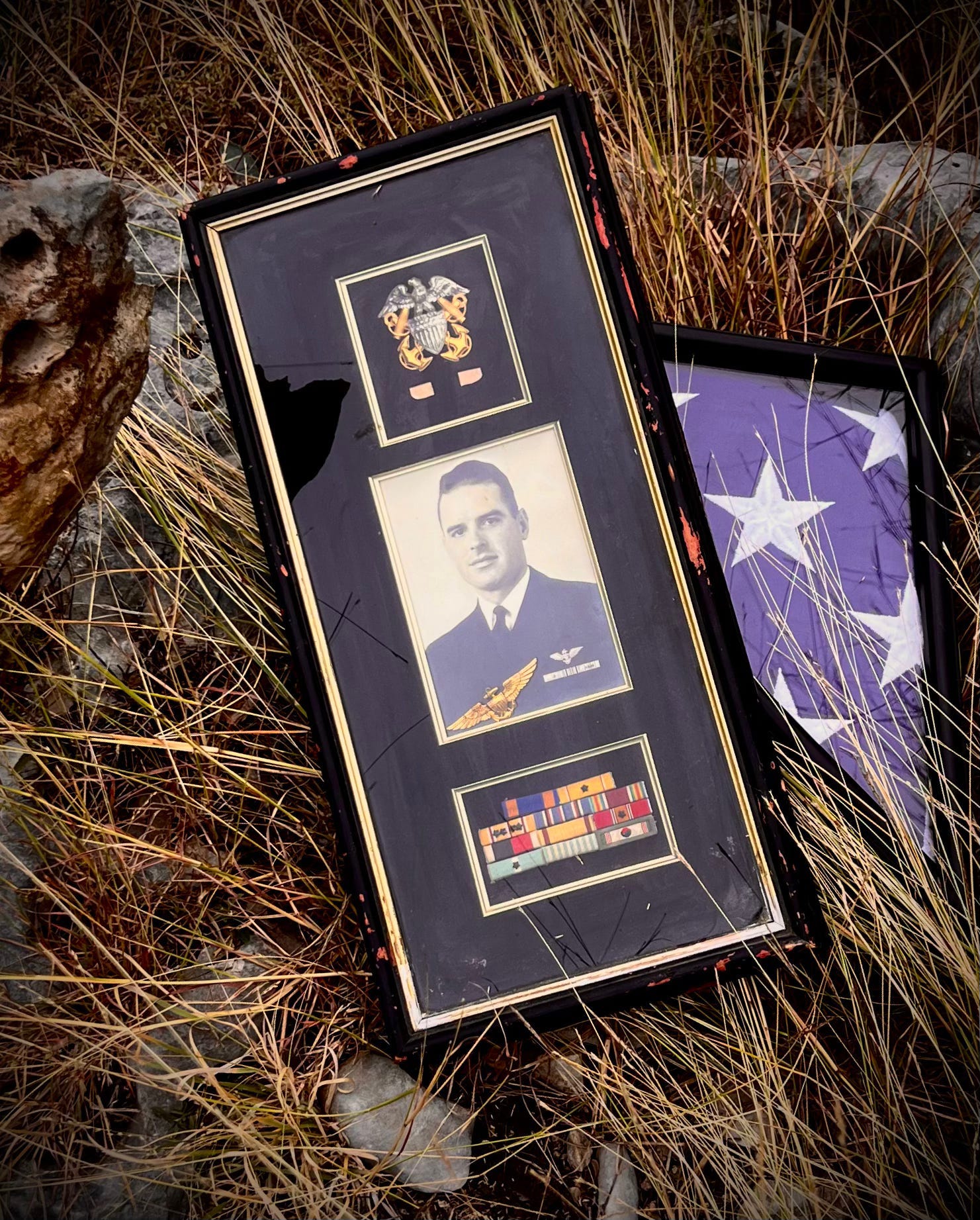
I grew up in the Navy. I married an Army Officer. Between us, both fathers and my husband’s uncles, Warner, Walter, Max and Paul served as military pilots in World War II and Korea. For our families, Memorial Day has never been just another excuse for hot dogs on the grill.
God and Country are in our blood, beginning with the American Revolution to the Texas Revolution, Civil War, World War I, World War II and Korea…with future generations standing by for whatever comes next.
My Dad graduated from Annapolis in 1941 at the tender age of 22. He immediately shipped out from Pearl Harbor as Torpedo Control Officer aboard the naval destroyer USS Preston, with orders to the Solomon Islands.
The Preston served as part of a destroyer screen for the battleship USS South Dakota and the fleet carriers Hornet and Enterprise. In her first major action, she engaged in one of the fiercest naval battles in history — the Battle of Santa Cruz Islands, October 26, 1942.
Weeks later, Preston steamed toward Guadalcanal in battle formation with five destroyers and two battleships.
Midnight at the Battle of Guadalcanal
Just after midnight on November 15, 1942, as the Preston entered the darkened channel called the slot, she was suddenly surrounded.
All hell broke loose.
They managed to fire off a few rounds and a salvo of torpedoes before taking multiple point blank hits from a Japanese cruiser’s 11 inch guns. Explosions lit the channel bright as day. My Dad, LTJG Marx watched in horror as the ship’s hull tore apart in rending, molten metal.

Captain Stormes was forced to give the order “All hands abandon ship!” — and was himself lost as the PRESTON rolled a sickening 90 degrees to starboard. Standing next to him on the bridge, my Dad, LTJG Marx, simply stepped off the port side and started swimming. The PRESTON upended and sank stern first into the roiling sea in twenty seconds.
Looking straight up, he saw the terrifying bow of battleship Washington bearing down on the pitiful handful of fellow survivors roaring like a freight train. Catching her bow wave, he rode it out to avoid the tremendous and terrifying suction. As she passed, a crew member tossed over a cork ring life raft. My Dad, grabbed at this dubious chance for life, clinging to the flimsy net raft throughout the whole terrible night.
Surrounded by screams and moans of hundreds of injured and dying sailors, the battle raged on through the night. Depth charges exploded from sunken ships below. The tropical water turned cold. Eventually, he became aware that his sidearm was dragging him under. Unhooking his 1911 45 and gun belt, he let it sink into the deep.
Throughout the night, sharks circled and bumped them, though mercifully, the carnage of the previous days had already satisfied them. After eight hours, young Marx realized he was holding up his Kapok life jacket, not the other way around. He slipped it off and it too sank.
As the sun rose, they could see the bow of the USS WALKE, partially afloat, a Japanese sailor clinging to one side, an American to the other, both desperate to survive.
Mercifully it seemed, his remaining small band drifted toward a nearby island, though hope was again dashed as Japanese machine guns opened up. After fifteen harrowing hours in the water, LTJG Theodore Marx was rescued by a PBY float plane: severely sunburned, oil-soaked, and temporarily blinded by fuel. The survivors were unceremoniously doused in diesel and rinsed with a fire hose. They were issued Marine khakis, a pith helmet, and a small bottle of Brandy.
It was the last fight for the USS PRESTON with most of her young crew lost to the deep.
Guadalcanal proved to be a turning point in the Pacific War, ending the Japanese offensive and opening the long island-hopping march to Tokyo Bay. The channel was later renamed Iron Bottom Sound as some 200 ships of both sides lay there forever. Those waters are sacred territory.
“They fought together as brothers in arms; they died together and now they sleep side by side. To them we have a solemn obligation to ensure that their sacrifice will help make this a better and safer place to live.”
Fleet Admiral Chester Nimitz, USN
My father made himself a promise that night in the water.
He was going to do something safer.
He became a Hellcat pilot.
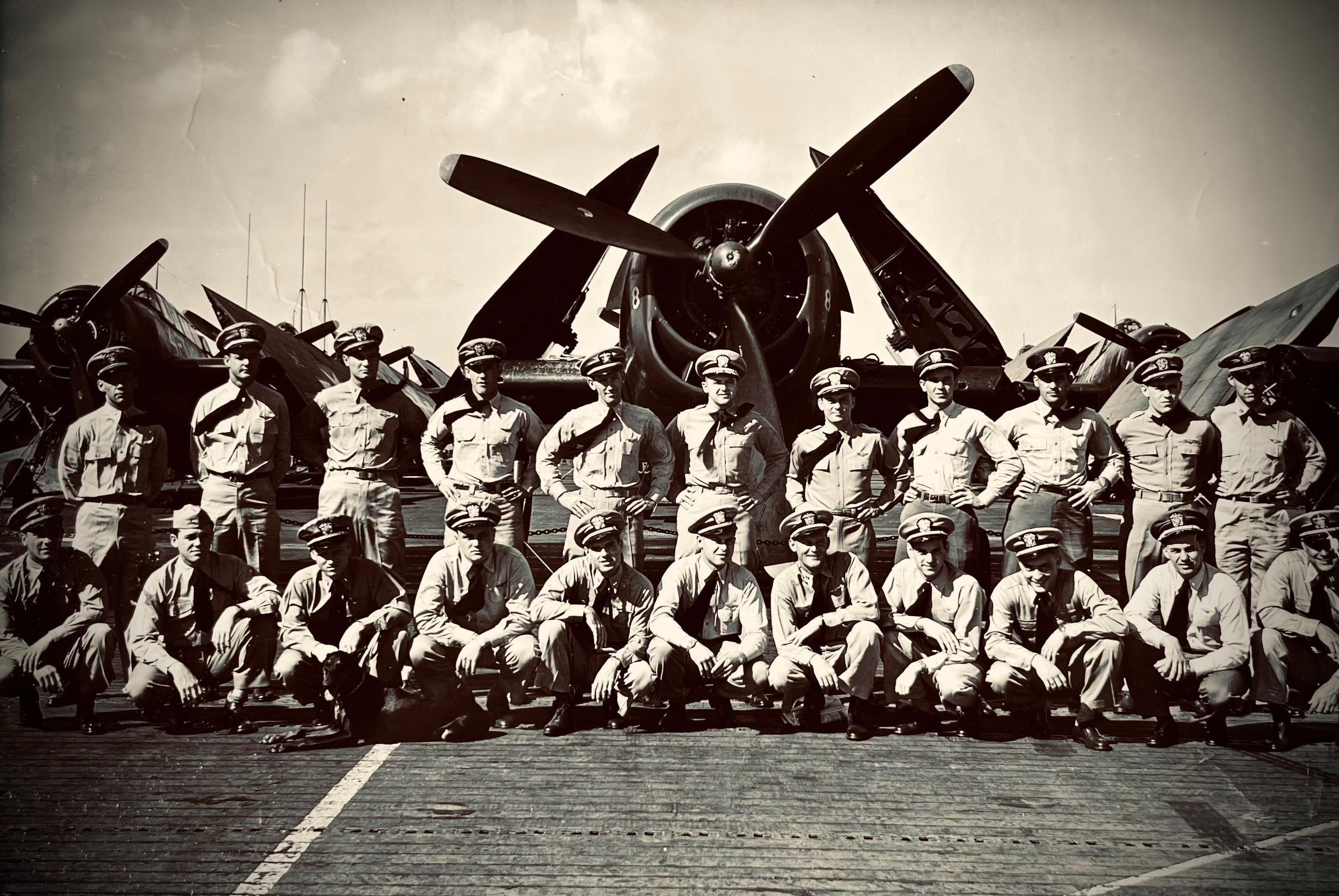
After thirty years Dad retired from the U.S. Navy, most of his shipmates were buried at sea.
“We few, we happy few, we band of brothers; for he today that sheds his blood with me, shall be my brother”…
William Shakespeare
That, is the story of my father’s war.
The following heroes of my town Fredericksburg.
In honor of Memorial Day this week, Chuck and I went to place flags on Veteran graves.
We had a list, 4 bundles of small American flags, and the German Hill Country cemetery that has been holding it’s dead since 1840. Der Stadt Friedhof — The City Cemetery.
The families buried here built this town. Weirichs and Burrers and Roeders. German names, Texas soil, generation after generation.
We worked our way up and down, row by row. Some of the graves easy to find. Some ancient stones you’d almost walk past without notice
Three of them stopped me cold, though I’m sure there were many others.
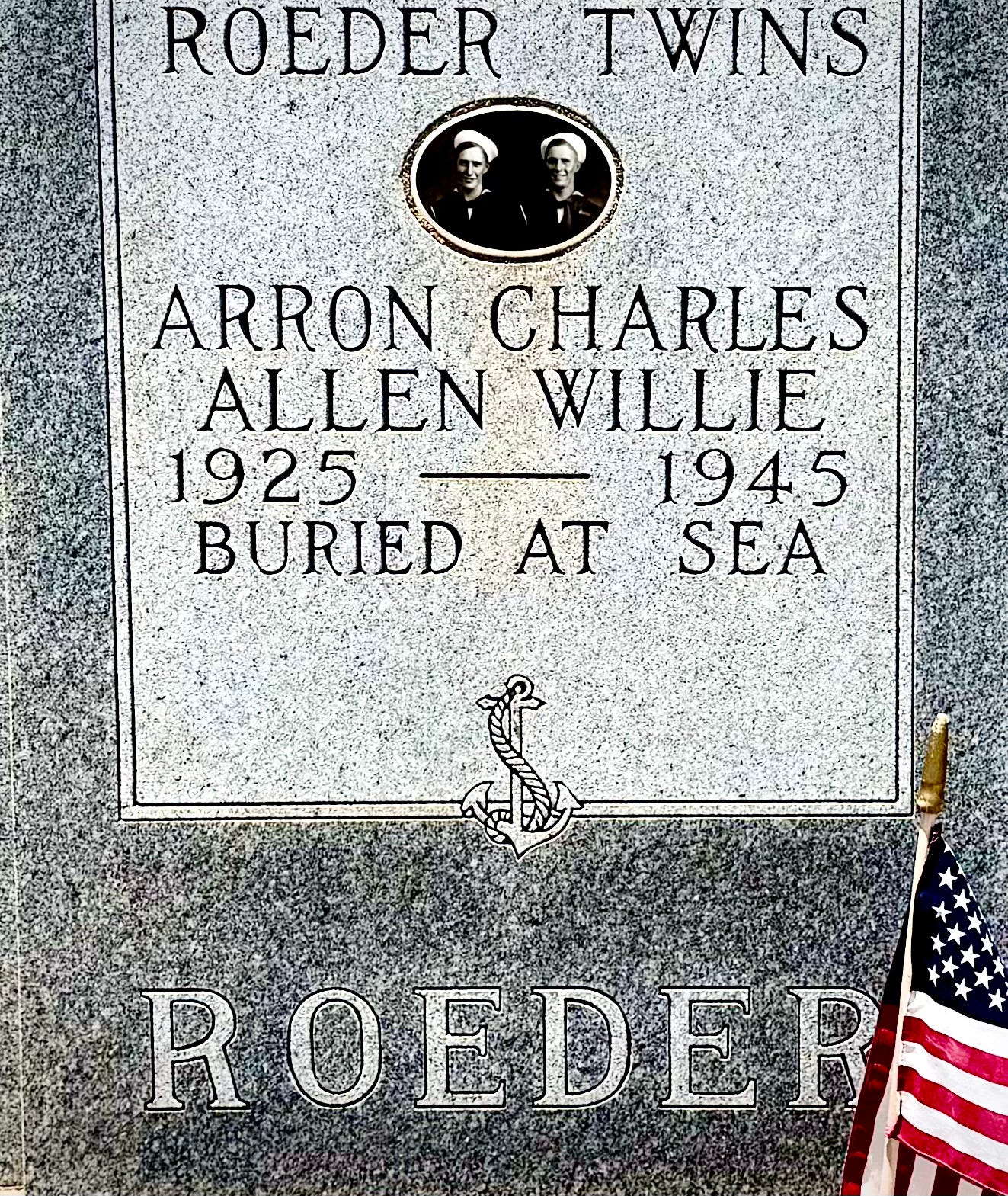
Aaron Charles Roeder and Allen Willie Roeder. Born October 1925. Died February 21, 1945. Nineteen years old. Both of them, the same day, buried at sea.
I stood there for a long moment, picturing their mother’s grief when she got the news.
The Roeder twins graduated from Boerne High School in 1944 and enlisted in the Navy together — two boys from a German Texas family, shipping out to the Pacific side by side. They were assigned to the USS BISMARCK SEA. Aaron at the aft guns. Allen up forward.
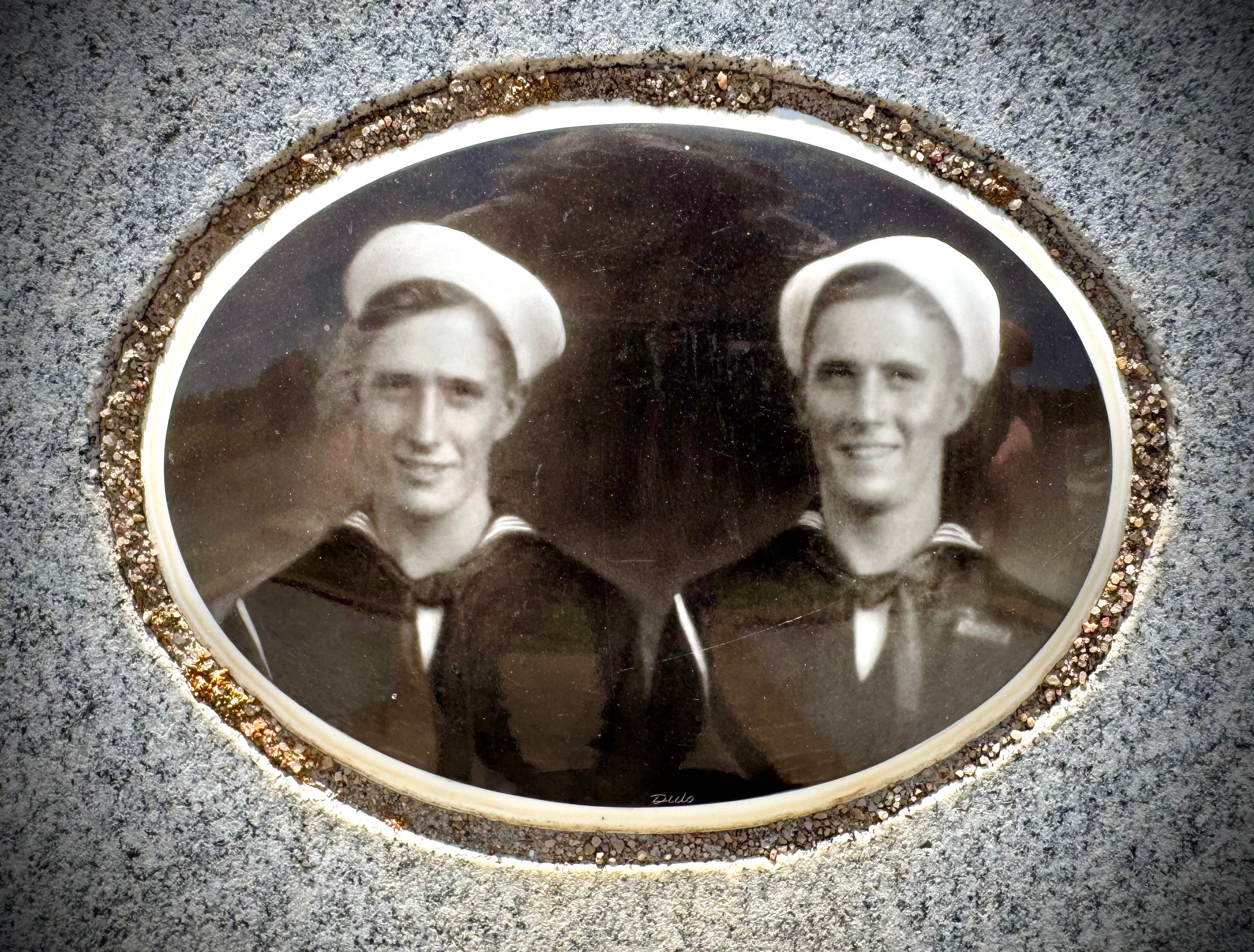
On the night of February 21, a swarm of Japanese Kamikaze planes hit the ship. It was going down fast. Allen went back to find Aaron before he would abandon ship.
He wouldn’t leave without his brother.
The BISMARCK SEA sank in less than 90 minutes. Neither boy came home.
Their parents later gave land to the city of Boerne in their memory- Roeder Park. A quiet piece of Texas that exists because two boys loved each other enough to go to war together, and one loved the other enough not to leave.
I planted a flag at on each side of the stone.
A few rows over I found Guenther August Burrer. Born 1917. Died 1951. His photo, which Chuck immediately identified as a Paratrooper was simply placed between his parents on the family headstone and poignantly read, IN MEMORY OF SON, GUENTHER.
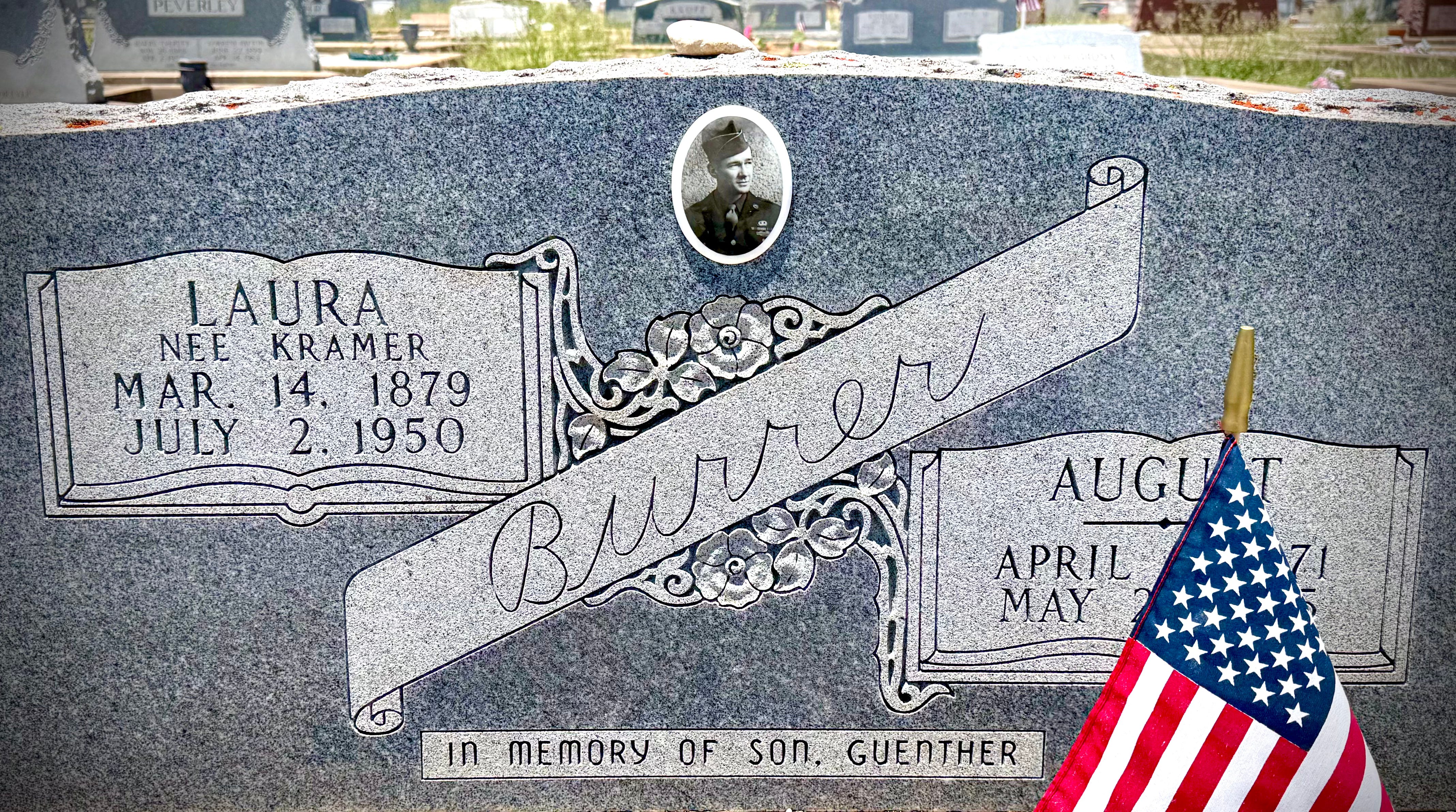
Guenther grew up in Fredericksburg. He enlisted in 1940, became a paratrooper, and served with distinction jumping into Europe in World War II. Then Korea and he went again.
In a letter to his father, written just weeks before he was captured, he mentioned he had seen 161 days of combat out of 164 days in-country.
Three days off. In six months.
On February 12, 1951, he was captured near Hoeng-Song, wounded. A fellow soldier taken alongside him, later released after being badly wounded himself, wrote to Guenther’s father from a hospital in San Francisco. He offered that during their time as prisoners together, Guenther had spent most of his strength helping the wounded man make the march north. “I owe your son a lot,” he wrote. “Without him my way would have been far more difficult. He is a great guy.”
Guenther Burrer died in a Communist POW camp on May 15, 1951. Beri-beri. A preventable disease. He was 33 years old. His memorial service was held at Zion Lutheran Church, in the town where he was born.
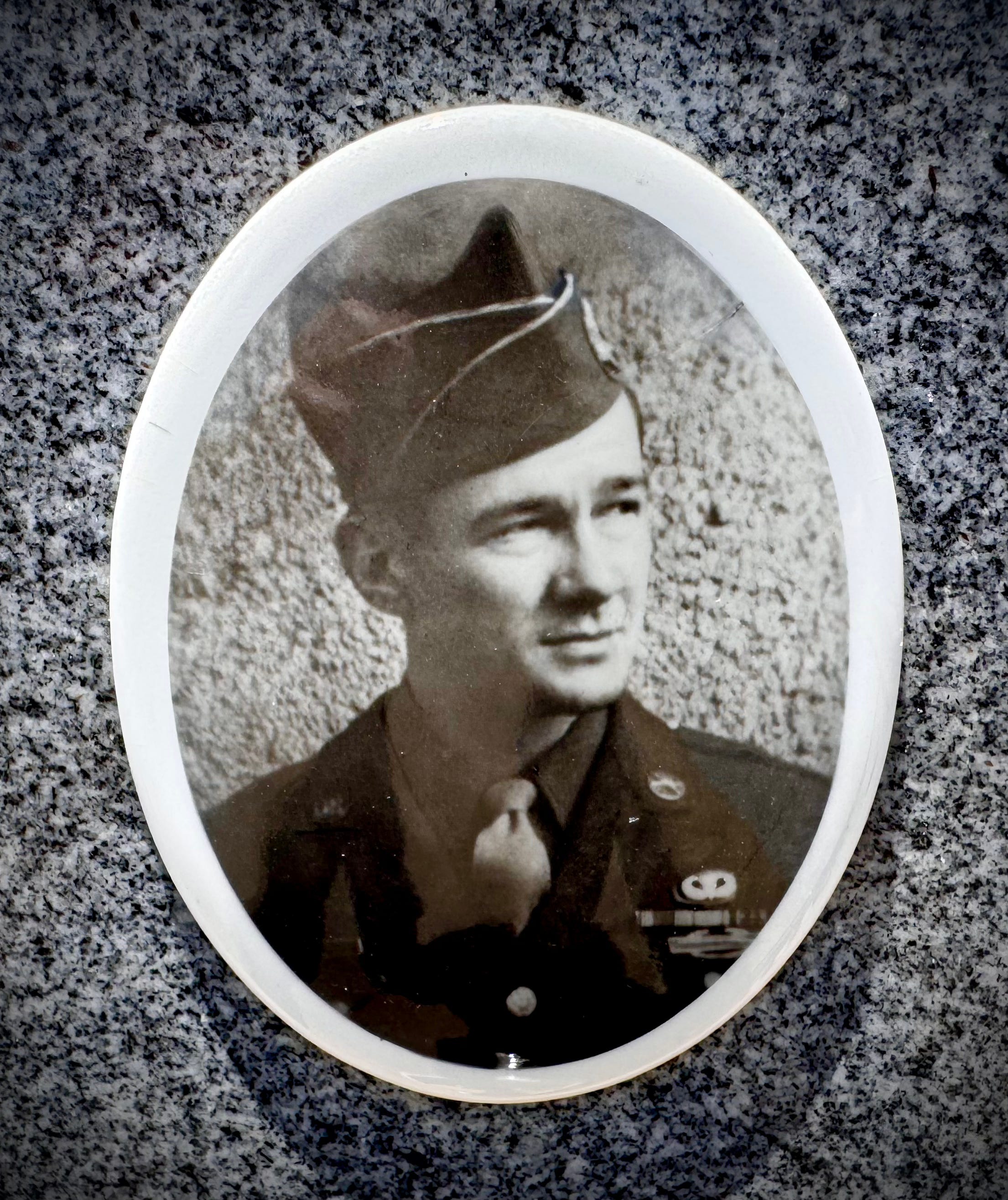
I pushed a flag into the ground beside the family headstone and stood there thinking of the immeasurable suffering of this Korean POW, yet courage untold, simply a photo of their decorated Paratrooper memorialized on the family tombstone.
The third stone was the quietest. Weathered, plain, easy to miss.
Weirich, Arwin Otto. 1893–1951.
And then, almost as a footnote: Balloon CO AS, the Air Service, I later discovered.
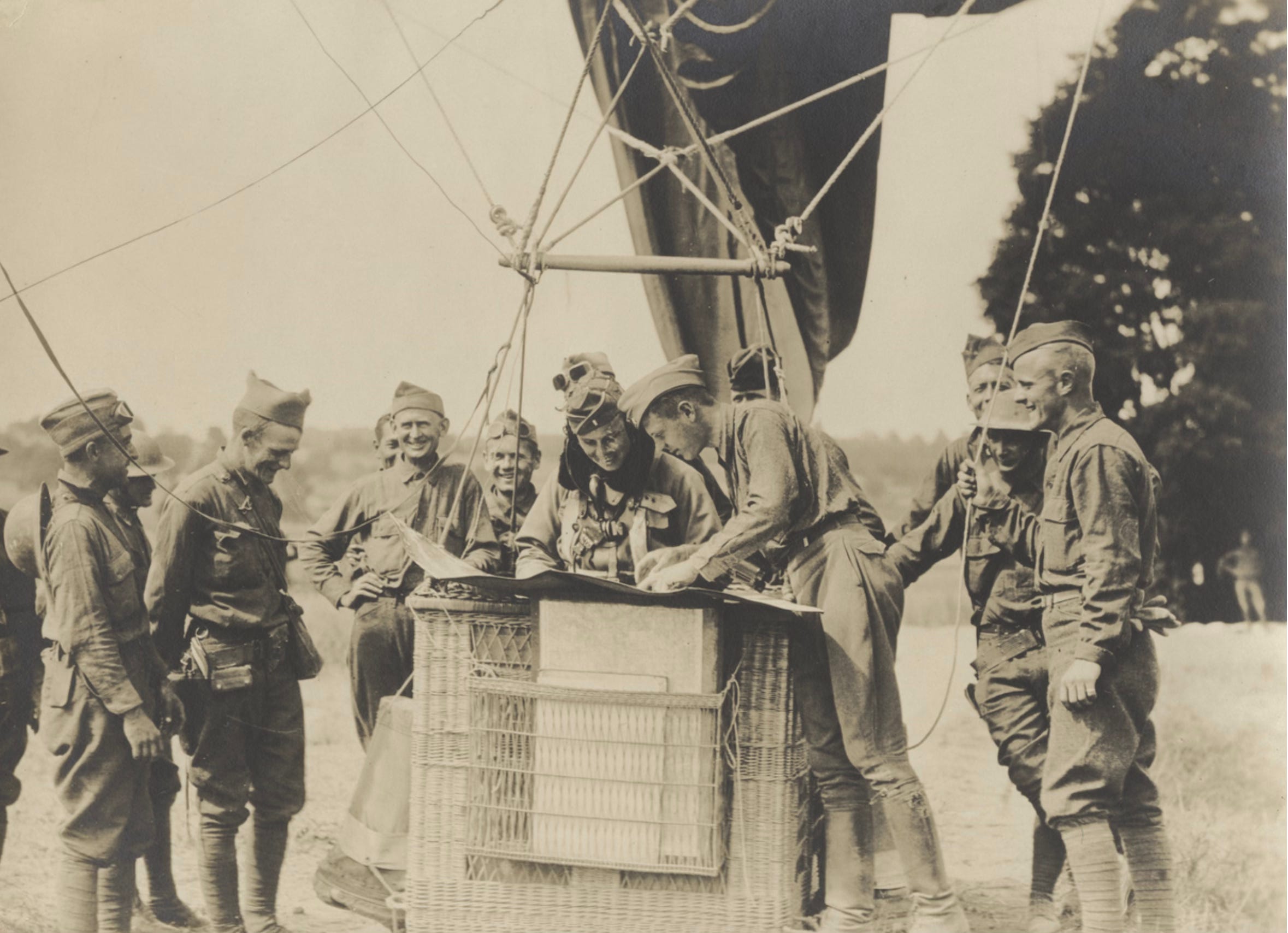
Arwin Otto Weirich was born in Fredericksburg in 1893, the son of German immigrants. He grew up speaking German at the kitchen table. He worshipped in a German church. He carried a German name.
In 1917, the United States went to war with Germany. From Fredericksburg, German Americans fighting Germans.
He went anyway.
The Army Balloon Corps sent observers up above the Western Front in hydrogen-filled envelopes, tethered high over the battlefield, calling in artillery coordinates. They were massive, unmissable targets. Enemy pilots hunted them. These men were called the Angels of Hell.
Arwin came home. He quietly lived out his years in the Hill Country, grew old in the community his grandparents had built, and was buried here in the Der Stadt Friedhof with the rest of his family.
A German-Texas man who went to war against Germany, answering the call to duty, floating above the worst of it in a hydrogen balloon, yet somehow survived.
Some kinds of courage don’t make the history books. They just end up in the ground in a quiet cemetery, waiting for someone to stop and notice in awe. We did that.
I kept thinking about what it means to go anyway. To show up for something larger than yourself, even when the cost is everything. Even when you don’t come home. Even when history forgets to write your name down.
These four men a pair of Navy twins, a twice-deployed paratrooper, his remains left behind in a Korean POW camp, a man who floated above the Western Front in a balloon were all buried in the same small German cemetery in the same small Texas town. Their families built this community with their hands. And then, when the time came, they sent their sons.
Memorial Day, for me, will never just be a long weekend.
It will be a cemetery, a bundle of flags, and head stones that stopped me cold.
It will be Aaron and Allen, Guenther and Arwin. It will be my father. God bless them all. Remember them, America, this special Memorial Day.
I cried for the men, for families…for all Veterans. It will be the irreplaceable weight of names too often forgotten.
Who will you remember this Memorial Day?
I’d be honored if you would send this to others.
So many sacrificed everything so that we might live free. These men and women are truly heroes by every definition. One day a year to remember their sacrifice is not nearly enough. Thank you, Anita.
Amazing stories from one small area. Imagine and remember the ones we will never hear. God Bless the USA and keep/ get her lines on the straight and narrow path to do your will.
Anita you have a documentary in this one article!